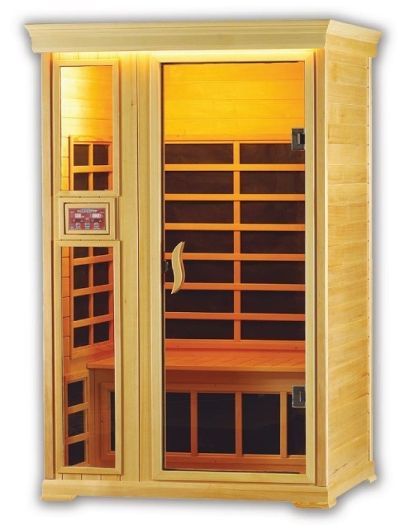
Frequently asked questions: What is the difference between an infrared sauna and a heat cabin?
The conceptually distinctive terminology has only developed in common parlance in recent years. Infrared saunas refer to cabins with rod emitters (and possibly panel emitters). In heat cabins, on the other hand, only panel emitters are used. Accordingly, the areas of application are also different.
Infrared Saunas
Infrared saunas, if they have an intensity control, initially have the same applications as heat cabins, although admittedly they cannot achieve the same uniformity of radiation due to the rod emitter. If the intensity of such a cabin is reduced, it results in a gentle irradiation of the body.
The biggest advantage of infrared saunas over heat cabins is the deep heat effect and the associated additional applications. Infrared rays of a specific spectral range penetrate into the lower layers of the skin and heat the tissue directly. This can be used to treat local pain and tension as well as some other symptoms, and it also gently raises the body's core temperature, which in turn kills harmful bacteria.
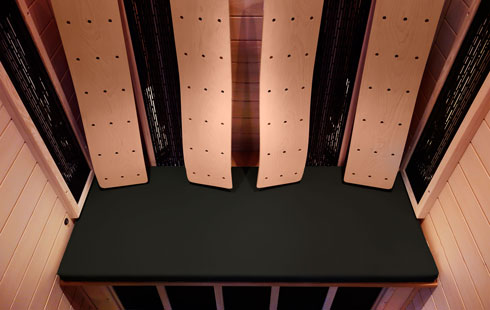
Heat Cabins
Heat cabins consist of a wooden cabin with built-in panel emitters. The emitters are arranged in such a way that they can irradiate the largest possible part of the body uniformly. These panel emitters only emit infrared-C rays, as the surface temperature is below 100°C. However, this does not mean that heat cabins have no practical use. On the contrary, heat cabins are excellent for fighting off colds, especially in the winter months. Simple warming up and relaxation are just as possible as intensive sweating and detoxification of the body. The circulation is stimulated, metabolic processes are boosted, and the body's natural self-healing powers are strengthened. Heat cabins are therefore very similar in their application to a bio-sauna, although the sensation of heat in heat cabins is somewhat more intense compared to the same temperatures in bio-saunas.