Frequently asked questions: What is infrared?
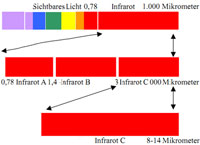
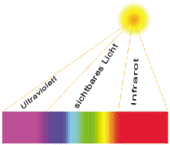
Infrared radiation is also known as thermal radiation and is part of the electromagnetic spectrum. It adjoins the visible light spectrum and has a wavelength range from 780 nanometers to 1 millimeter.
The largest natural source of infrared radiation is the sun. As the earth is warmed by solar radiation, it emits infrared radiation. Due to the absorption of radiation by artificial and natural gases in the atmosphere, additional global warming occurs.
There are three types of infrared radiation:
- Infrared-A radiation is short-wave and has a wavelength range of 780 nm to 1400 nm.
- This is followed by Infrared-B radiation from 1400 nm to 3000 nm.
- Then comes the long-wave Infrared-C radiation with a wavelength range of 3000 nm to 1 mm.

Infrared radiation was discovered in 1800 by Friedrich Wilhelm Herschel. During an experiment, he wanted to measure the different colors of sunlight. He used a prism to let the sunlight pass through and used a thermometer for the various color ranges. He found that the highest temperature reading occurred beyond the red end of the visible color spectrum. From this, he concluded that sunlight continues beyond the color red.
In the medical field, infrared rays are used specifically for the treatment of diseases. To accelerate healing success for various clinical pictures (especially skin diseases such as psoriasis), the use of IR-A radiation is sometimes necessary.
The application of IR-A should be done after instruction or with a therapy plan. The irradiation times are continuously increased, especially for beginners, to avoid overstraining the skin.
In the wellness sector, the most popular radiation is in the Infrared B range, which has few to no side effects and has a positive effect on the body.
However, Infrared-C radiation, e.g., from panel heaters, has no deep heat effect and is particularly suitable for gently warming up the body and heating the room.
Regular irradiation with deep heat radiation (IR-A and IR-B) stimulates blood circulation and gently relieves muscle tension. Additionally, infrared radiation strengthens the immune system.